
by Paul Steinberg


Editor’s Note: Late last week the Chronicle alerted Croton officials that the IDEA Advisory Committee, an official village committee, had impermissibly involved itself in determining which local news outlets were “legitimate” and which were not. As we reported earlier today, village officials are now consulting with the Village Attorney about the matter. Paul Steinberg, a frequent commenter on village affairs, offers some expert context about the episode in this Guest Editorial.
Village committees serve important functions in Croton. Members are not paid, but they are part of the village government and as such are subject to village policies and the laws of New York State. The IDEA Advisory Committee seems to be unclear about its mission and also about the United States Constitution.
Part of the fault can be put on the Village Manager and trustees for failing to exercise oversight and tolerating policy violations. The core problem is IDEA’s refusal to respect minority viewpoints and the rules ensuring minority rights. This can be seen even on the IDEA page of the village website.
On the official village website, the IDEA committee lists its contact email as a Gmail address. This is in explicit violation of the Croton Board and Committee Member Guidelines (“Guidelines”), which require use of “an official Village email account to facilitate record retention.” That mandate is in the paragraph explaining that committee records are village records subject to the New York Freedom of Information Act (FOIL).
This is not a new policy in Croton; it goes back to the Greg Schmidt administration and is grounded in state law requirements. IDEA’s predecessor (Diversity and Inclusion Committee) was established in November 2018. More than seven years later, the Board of Trustees has not seen fit to bring the committee into compliance.
Even when committee members are emailing among themselves, the email chain should always “cc” the official email account. Village trustees are subject to a stringent email policy. The trustees are aware of Croton policy and state law, and yet the trustee liaisons to IDEA have not brought IDEA into compliance.
This is not a minor violation. Village committees are an arm of the municipal corporation and thus an arm of the State of New York. Their records are subject to state law, including FOIL and litigation discovery.
Every government body has obligations which fall to the designated records officer. Unless the Village Clerk is able to gain independent access to the government records, there is a violation of the Guidelines as well as state law: it is not up to IDEA members to decide what documents to produce in the event of a disclosure demand (including FOIL).

This becomes of critical importance when IDEA ventures into discussion of violating a person’s Constitutional rights, as was done at the June 12, 2026 meeting. But the violation of rights began even before the meeting came to order.
The Guidelines state that “advisory committees shall endeavor to provide meeting agendas” because “sharing of agendas in advance of a meeting affords the Village an opportunity to provide guidance and feedback to committee leadership.” The requirements include “a list of all agenda items with brief descriptions.”
The IDEA agenda for the June 12 meeting said the meeting would cover June events, the upcoming Hispanic/LatinX history month, and Item 4 was simply listed as “New Business.”
The purpose of an agenda is to provide notice of the topics to be discussed. The most important part of an agenda is a specific description of what new business is going to be taken up. Hiding the topics that will be discussed is not transparent government, and is in violation of the village’s guidelines. This is particularly true when one of the topics to be discussed is a specific person.
It would be a stretch to describe the official village record as “minutes” of the meeting. IDEA does not list the items normally found in minutes, let alone those of a government agency conducting government business.
It does not list the names of the persons attending, whether there was a quorum, what time the meeting began and ended, which members discussed which items, or even a proper description of the discussion. Who spoke? What did each committee member say?
This information is absent from the June 12 IDEA minutes. It is unlikely it will ever make it into the minutes, since it appears that IDEA does not begin its meetings in the customary fashion of approval of the previous minutes.
Minutes are not only government records, they are historical records. It is important to know who said what in shaping government policy. Even when IDEA minutes identify attendees, it is by first name only. It is perfectly acceptable to identify a person fully in the beginning portion of the minutes as “John Doe” and then say “John thought a stop sign is needed” in the discussion portion. But it is not acceptable to completely fail to identify the person.
IDEA acts as though this is a kids’ treehouse club: if you don’t know who “[first name]” refers to, then you are not in the club. It is an exclusionary practice highlighted by the surname identification of “Michael Balter” and “Mr. Riley.” [sic] This is a means of othering those who are not part of the club.
There is also an item in the January 9, 2026 minutes: “Follow up with the ‘Latin American mayor of Croton’ to understand communication strategies for the Latin American community.” Who is the Latin American mayor of Croton? If you don’t know, that means you are not part of the club.
Use of in-group language to raise barriers to communication and isolate out-group members is criticized (and rightly so) by DEI advocates. In Croton, it is a practice centered by the IDEA committee. Given the common criticism of the practice in DEI circles, it is hard to believe this is not deliberate.
The minutes of Croton committees are part of Croton history. A researcher in 2126 will not know who IDEA committee members Cristina, Will and Millie are, let alone who was the Latin American Mayor of Croton. There are both statutory and historical concerns when the IDEA members run this like they were meeting in the treehouse to decide between playing stickball or going to the movies.
As a government body, the power dynamics of exclusionary language have legal ramifications. Croton is a clubby place run by a handful of people (until recently, people sitting on multiple committees.) And those elites are not averse to using government to silence free speech. Former code enforcement officer Thor Snilsberg found that out the hard way, and at the June 12 IDEA meeting, the members discussed how to silence The Croton Chronicle’s editor, Michael Balter.

IDEA is required by the Guidelines to submit meeting minutes which contain specific information, including samples of how the Agenda and Meeting Minutes should look. The IDEA committee simply ignores the guidelines.
The June 12 meeting covered recent and upcoming events (Pride, Juneteenth, Lorraine Hansberry Coalition), followed by procurement matters. Then the meeting turned to an item not disclosed on the agenda.
The meeting minutes say: “Michael Balter’s Reporting: Concerns about Michael Balter’s reporting style, mixing news with opinion, and the Village’s platforming of his blog as legitimate journalism.”
Who discussed Michael Balter? What did the person(s) say? What is meant by “concerns” and “platforming”? Which members of the committee held that Mr. Balter does not produce “legitimate journalism”? Did any members object? Did any members mention the First Amendment and its applicability to a government body such as IDEA?
Reportedly some non-members of the IDEA committee participated in the discussion about Michael Balter, as well as at previous meetings. At the January 9 meeting, the committee announced it would introduce a new policy allowing Public Comment, with a limit of three minutes per person. It appears that that rule was due to Croton resident Ed Riely, and that IDEA has never subjected any other person to the three minute limit.
The June 12 agenda does not reflect provision for Public Comment, nor do the minutes indicate any non-members present, let alone participating.
That means that the discussion of Michael Balter was not raised by someone griping during Public Comment: this was a discussion by persons operating in their governmental capacity as members of a group appointed by the Mayor, and they were talking about how to violate a resident’s Constitutional rights.
That a government body is convened for the purpose of discussing the “reporting style” of a resident should concern all of us. At the very least the public agenda should have given Mr. Balter advance notice. Even a kangaroo court lets the target attend the show trial.
Returning to IDEA use of insider lingo: what do they mean by “the Village’s platforming of his blog as legitimate journalism”?
Mr. Balter’s platform is the Substack-based online newspaper The Croton Chronicle. That platform is not under the control of the Village of Croton, nor does the village have any grounds to attempt to have Substack throw Mr. Balter off the platform.
IDEA members should clarify what they mean by “platform.” I suspect that IDEA is trying to say that village officials should not talk with Mr. Balter. Behaving as bullies on the playground, IDEA would have Mr. Balter shunned by the other kids. No birthday party invites for you, Mikey!
In fairness to IDEA, this is a path blazed by the autocratic Ana Teague, current president of the Croton-Harmon school district. Recently, the school district has seen the light after getting a letter from a reporters’ rights organization. And the Croton trustees tried to silence Lenny Amicola, but a letter from the US Department of Justice stopped that plan.
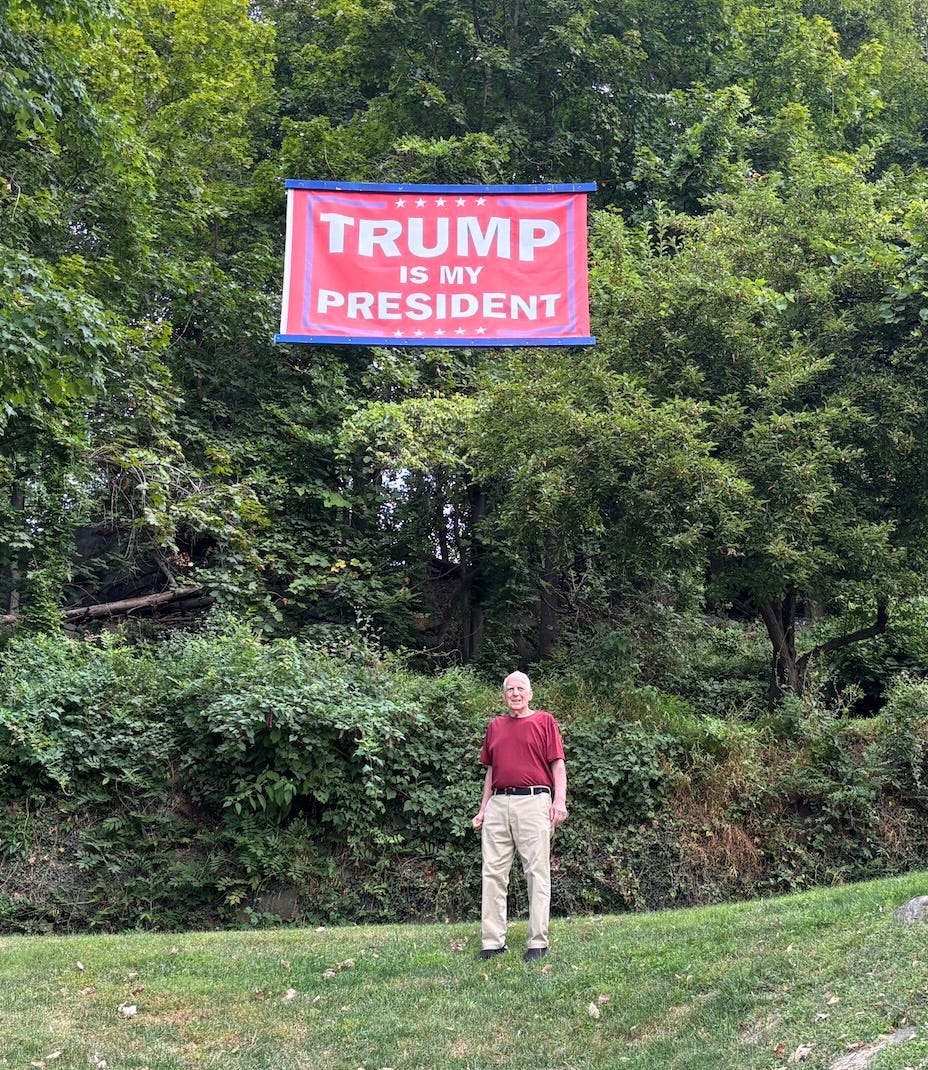
Shunning may occur on the playground. When an arm of the government shuns, that raises Constitutional concerns. We are obsessed with No Kings, but ignore the petty tyrants in our Croton backyard.
Due process requires that before Croton takes an adverse action based on a failure to engage in “legitimate journalism” that the Board of Trustees must pass a resolution defining “legitimate journalism.” Our trustees defined antisemitism; IDEA feels the next step is to define what constitutes governmentally-acceptable journalism within the confines of Croton-on-Hudson.
I have asked around, and nobody seems to understand what IDEA members have against Mr. Balter. He is a firm supporter of IDEA’s flagship (pun intended) Pride events and is left-wing not just because it is fashionable but because he actually believes on a philosophical level, and has done so since his activist days during the Vietnam War.
Many of Mr. Balter’s beliefs are not ones I share, but he has a right to freedom of speech which even IDEA members may not abridge. Croton’s school board and now Croton’s IDEA committee have targeted the free speech of someone who was a progressive activist before most of us were born.
That should make us all wary. It was one thing for the municipality to go after Lenny Amicola; he was and remains guilty of wrong-think. But Michael Balter has been a leftist since he engaged in civil disobedience in the Army and accepted lifelong consequences. Even if you disagree with his actions, they are precisely the type of activism which one would think is respected in Croton.
Mr. Balter is not the only candidate for the Orwellian re-education treatment. IDEA has also observed that there are “co-naming detractors” who object to the co-naming of a section of Cleveland Drive as “Lorraine Hansberry Way.” At the June 12 meeting, IDEA took up the “community pushback regarding Hansberry’s perceived political affiliations (communism) and the need for educational talking points from the Village.”

At the risk of becoming an agenda item at the next meeting, I must point out that Hansberry is “perceived” as communist because she was a communist. Not that there’s anything wrong with that, as the “Seinfeld” character Ned Isakoff would tell you.
Hansberry’s communism is not “perception.” It is a fact. The National Museum of African American History & Culture (part of the Smithsonian) states: “Hansberry, an outspoken Communist, was committed to racial equity and participated in civil rights demonstrations.”
Our schools don’t teach history anymore; they indoctrinate. One result is that people can’t contextualize. If I were a Black lesbian in the 1950s, I would have been a communist too. It was a rational decision then, even if less so in hindsight. But there are Croton residents who are vehement in their feelings about Hansberry and about communism in general.
Why was Hansberry a Communist? Why was she outspoken about such a belief at the height of the Cold War? Those are very good questions. And that is why we have the Croton Historical Society, the Friends of History, and the Lorraine Hansberry Coalition. It is why we have museums, and lectures in the Croton Free Library’s Ottinger Room.
It is not for the IDEA members to discuss how to push back against Croton residents objecting to communism. It is not for the municipality to lecture us on why Hansberry was not a communist but only “perceived” as such. There is no need for Croton to develop “educational talking points.” Objectively speaking, it is logical for the Board of Trustees to define communism just as they have defined antisemitism. But it was unwise for Croton to officially define antisemitism, and we don’t need to target residents who hold the (factually correct) belief that Hansberry was a communist.
The 2025-2026 Croton budget gives $7,000 of taxpayer funds to the Lorraine Hansberry Coalition. If there is a need to educate residents as to why communism is a good thing, or why Hansberry wasn’t a real communist but just “perceived” as communist, that is a job for a museum or non-profit. It is not a proper role for our village government.
The June 12 meeting also had a discussion of how to access the Village of Croton accounts at ShopRite, Buchanan Hardware, and Amazon. I would question why everyone on a committee needs to have purchasing authority, but that is a judgment call by Village Manager Bryan Healy.
I am concerned about the Village Treasurer passing out tax exemption letters upon request. In the case of the IDEA committee, I wonder what the committee needs which they cannot get through ShopRite or Amazon. Food for Hispanic day and flags for Pride month don’t require sourcing outside of village vendor accounts. If there is an unusual circumstance, this should be handled within the Municipal Building. Tax exemption letters are subject to fraud which is almost never detected. Agencies don’t care because there is no direct impact since the agency doesn’t shell out money. This is not simply an issue with a single committee, but rather it appears that these letters are given out routinely (Guidelines, Committee Financial Requirements number 7.)
IDEA concluded the June 12 meeting by saying that “All” members are to “Be mindful of Michael Balter’s reporting style and its potential for misinformation.” Presumably regarding Hansberry’s communist politics, follow-up is to “Continue to educate the community on historical figures and context to counter misinformation.”
What constitutes “misinformation” has not yet been defined. Perhaps that could be another Board of Trustees definition promulgated by resolution.
IDEA lists a key takeaway: “The rise of unofficial journalistic platforms necessitates critical evaluation of information and responsible communication strategies.” It might be helpful for the trustees to compile a list of which journalistic platforms are “official journalistic platforms.” Presumably The Croton Chronicle will not be on the list of Croton government-approved platforms.
If IDEA Advisory Committee chair Faith Rivers as a business owner (The Black Cow) chooses to host a Balter-bashing marathon at her business, the IDEA members can gather together as individual citizens and bash away. But when those same people gather as members of a government committee, they take on a civic responsibility. Or at least, they are supposed to do so.

***********************************************************************************************************
To share this post, or to share The Croton Chronicle, please click on these links.
Comments policy: No personal attacks or trolling. Please be polite and respectful at all times.
Once again I find the content in the Croton Chronicles one the most honest and informative sources of information regarding the village and its internal machinations available. For quite some time I’ve made various voices that are available via Substack subscription important and critical reading for myself. ( Heather Richardson and Robert Reich to name two.)
Er Koch was one of NYC’s most beloved mayors. However by the time his third term ended his administration was judged to be one of the most corrupt in NYC’s history. Koch himself was never thought to be responsible. It came down to an administration that became so entrenched that it believed itself invulnerable to outside scrutiny.
I’m absolutely NOT suggesting that the current village administration is corrupted in any sense of the word. Rather that a sense on entrenchment within the Democratic Party in the village has lent itself to a veneer of “correctness “ that allows various groups within the current administration (IDEA apparently front and center in the case) to ignore legal protocol as this article points out.
Michael and all those that subscribe and contribute to this Substack, keep up the excellent reporting and writing. As the Washington Post’s motto states, ( although rather hypothetically given their current owner) “Democracy dies in darkness”.
Doe's anyone know what the IDEA's issues with Michael and the Chronicle are? Is the IDEA too shy to be open and honest with the citizens who fund them? I am hoping for a factual answer not speculation.